
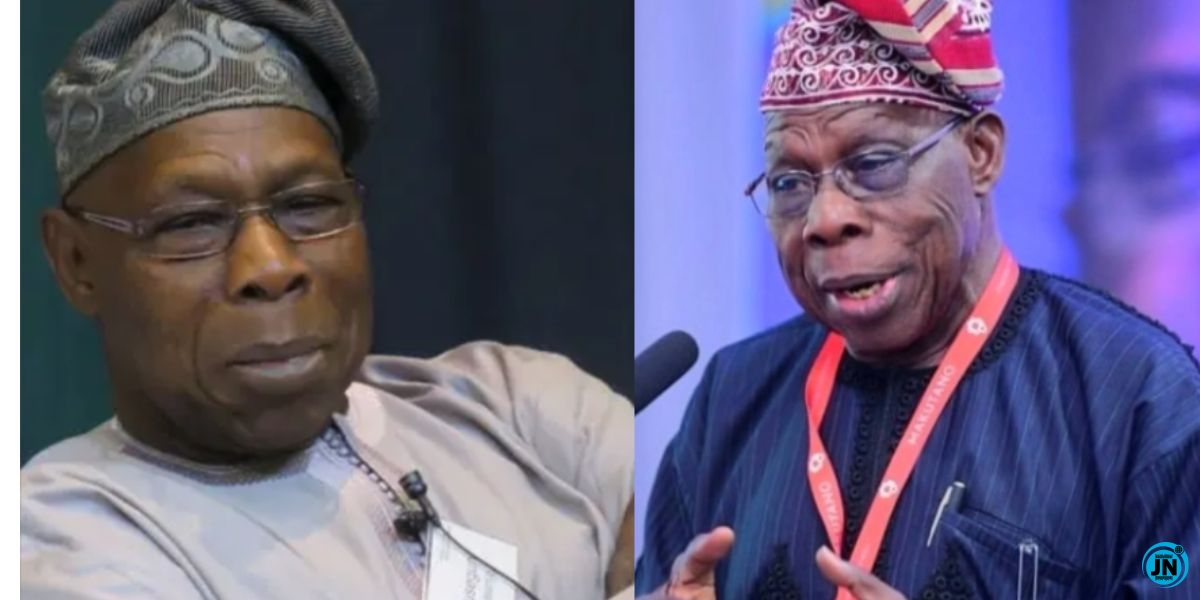
Former Nigerian President, Olusegun Obasanjo, has openly stated that he will never stop having children, explaining that the concept of childbirth goes beyond personal biological reproduction and extends through generations.
Obasanjo made this thought-provoking statement while hosting the leadership of the Paediatric Association of Nigeria (PAN), led by its President, Dr. Ekanem Ekure, at his residence within the Olusegun Obasanjo Presidential Library (OOPL) in Abeokuta, Ogun State, on Monday.
Speaking during the visit, the former president reflected on the continuity of life, stressing that although he no longer gives birth and his children are now adults, the cycle of life does not end with him.
According to Obasanjo, his children are now having children of their own, and his grandchildren will also continue the process, making it impossible for him to ever stop “having children” in the broader sense of legacy and lineage.
“I am no longer giving birth to children, and my children are now adults. But my children are still having children, and my grandchildren are having children, so I will never stop having children.
Because when I stop, my children will not stop, and when my children stop, my grandchildren will not stop, and the cycle continues,” Obasanjo said.
The former president went on to stress that the protection, care, and wellbeing of children should be regarded as a lifelong and collective responsibility shared by families, communities, professionals, and governments alike.
He noted that the strength and future of any nation depend largely on how well its children are protected, nurtured, and prepared for the challenges of tomorrow.
Obasanjo described children as the foundation of every civilisation and called for improved care, survival, and holistic development, emphasizing that neglecting child welfare poses long-term risks to national growth and stability.
He also commended paediatricians for the demanding nature of their profession, describing paediatrics as one of the most sensitive and challenging branches of medicine.
“The problem of dealing with children is that they are not like adults, so you must be able to feel for them. If it were myself coming to you as an adult, you would ask me where I am having the pain… but children won’t be able to say all that,” he said.
Obasanjo’s remarks underscored the enduring responsibility adults owe to future generations and highlighted the crucial role child welfare, healthcare, and advocacy play in sustainable nation-building.