
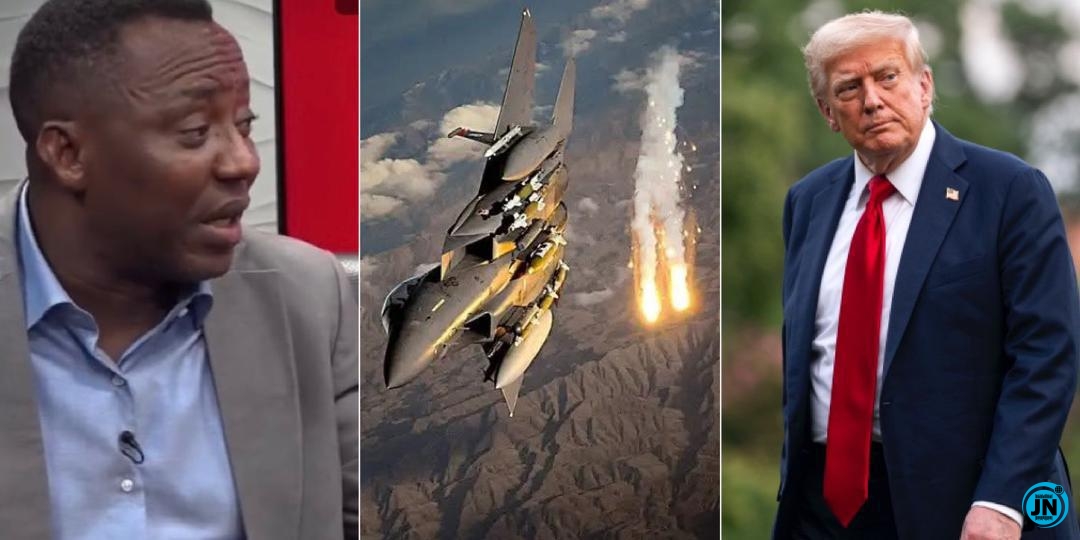
Former presidential candidate, human rights activist, and outspoken political commentator Omoyele Sowore has strongly condemned the recent U.S. airstrike targeting suspected ISIS fighters in northwest Nigeria, describing the operation as reckless and a violation of Nigeria’s sovereignty.
Sowore expressed concern over the broader implications of such foreign military interventions, warning that they could destabilize not just Nigeria but the entire West African region.
“Nobody should be rejoicing about this. This is an imperialist move on the part of Trump,” he stated, highlighting the danger of unilateral military action in another country without full consultation or regional consensus.
Direct Military Intervention Unacceptable – Sowore
Speaking further on the issue, Sowore emphasized that while international assistance and cooperation can be beneficial in combating terrorism, direct foreign military intervention within Nigeria’s borders is unacceptable and sets a dangerous precedent.
“The U.S. could help the Nigerian military with intelligence, training, or logistical support, but U.S. forces carrying out attacks inside Nigeria is extremely dangerous, reckless, and bad,” he added, pointing out that such operations could undermine Nigeria’s autonomy and inflame local tensions.
He described the strike as “a sad day for the so-called African liberation and independence,” suggesting that African nations must retain full control over their security affairs to truly safeguard sovereignty and peace.
Trump Claims Strike Targeted ISIS Fighters
The development comes after U.S. President Donald Trump publicly confirmed on his social media platform, Truth Social, that American forces had carried out a military strike against ISIS operatives in northwest Nigeria.
Trump asserted that the targeted fighters had been responsible for killing innocent Christians at levels he described as “unprecedented,” framing the strike as both retaliatory and preventative in nature.
“Tonight, at my direction as Commander in Chief, the United States launched a powerful and deadly strike against ISIS Terrorist Scum in Northwest Nigeria,” Trump said, emphasizing the operation’s lethality and the administration’s firm stance against extremist violence.
He further warned that these fighters had been cautioned previously about continued attacks on Christians and that the U.S. would act decisively should the violence persist.
AFRICOM Confirms Airstrike in Sokoto State
The United States Africa Command (AFRICOM) later confirmed the airstrike via its official X account, stating that the operation had been conducted “at the request of Nigerian authorities” and resulted in the deaths of “multiple ISIS terrorists.”
U.S. Secretary of Defense Pete Hegseth also acknowledged Nigeria’s cooperation in the operation and hinted at the possibility of further military actions in the region, although he did not provide specific details about any planned operations.
The airstrike was reportedly carried out in “Soboto state,” which appears to be a reference to Sokoto State, a key area of concern due to its proximity to the Sahel region and known extremist activity.
Residents Panic After Explosion in Jabo Village
The airstrike and its aftermath caused widespread panic among residents of Jabo village in Tambuwal Local Government Area, Sokoto State. Villagers reported hearing a loud explosion late on Christmas night, which immediately sparked fear and uncertainty across the community.
Eyewitnesses described the scene as chaotic, with residents rushing out of their homes to assess the source of the explosion and ensure the safety of their families.
“It happened suddenly in the night. The explosion caused fear, but thank God it did not land among people,” one resident said, recounting the immediate alarm and relief that no civilians were harmed. Many villagers expressed continued anxiety following the incident, questioning the timing and safety of conducting such operations in populated areas.
The airstrike has reignited debates on the legality, ethics, and strategic implications of foreign military intervention in Nigeria, with citizens and activists alike demanding accountability and clearer communication from both the U.S. and Nigerian authorities.