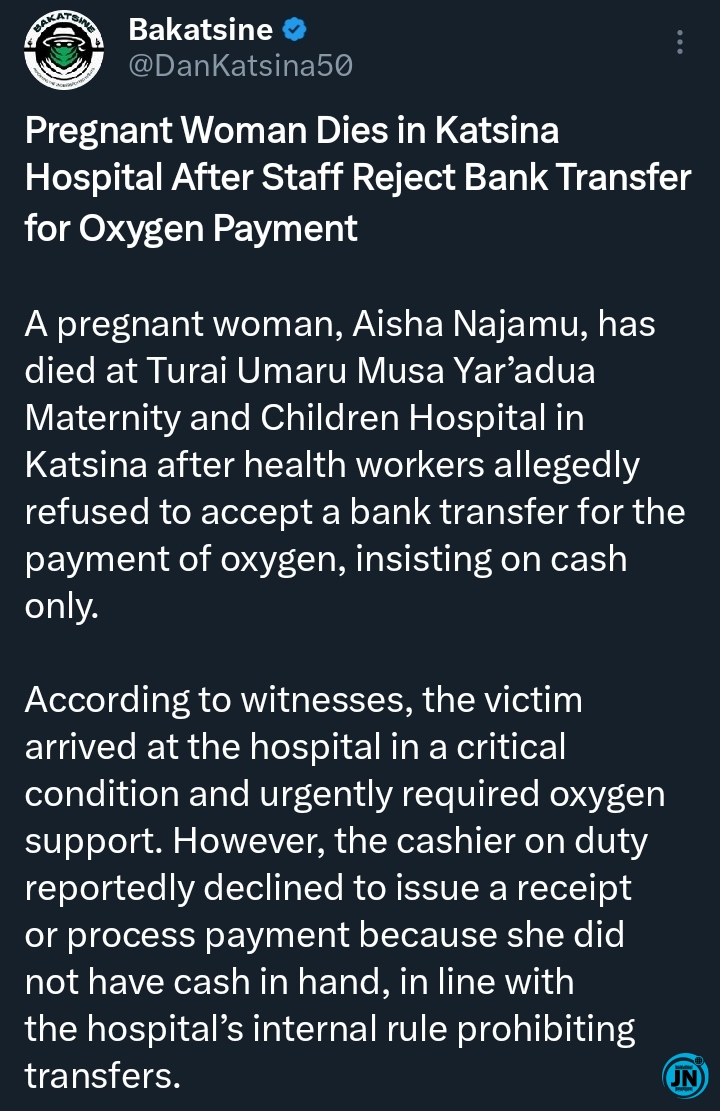
A pregnant woman, identified as Aisha Najamu, has tragically lost her life at the Turai Umaru Musa Yar’adua Maternity and Children Hospital in Katsina after hospital staff allegedly refused to accept a bank transfer as payment for life-saving oxygen, insisting that payment must be made strictly in cash before treatment could proceed.
Witnesses said the woman arrived at the facility in a critical condition and urgently required oxygen support to stabilize her condition as her health rapidly deteriorated upon arrival.
However, the cashier on duty reportedly declined to process the payment because no physical cash was immediately available, firmly insisting that the hospital’s internal policy does not permit bank transfers, regardless of how dire a patient’s situation may be.
Witness Describes “Distressing” Scene
A concerned passerby who attempted to intervene told Katsina Times that he pleaded repeatedly with the cashier to accept a simple transfer to prevent a needless loss of life.
He stated that the cashier was adamant that the hospital’s policy forbids the acceptance of transfers and must be obeyed without exception. According to him, he even volunteered to pay more than the required amount and later produced a $100 note in a desperate attempt to save her life, but all efforts were rejected.
He described the entire situation as “deeply distressing,” explaining that the pregnant woman cried out in pain and begged for help until she eventually collapsed and died at about 11:30 p.m., while helpless bystanders watched in shock.
Hospital Reacts, Promises Investigation
In response to the incident, the hospital management stated that it has not yet received any formal complaint directly from the affected family, except for one report that was forwarded by the human-rights group IHRAAC for investigation.
Cashier Aminu Ibrahim Kofar Bai expressed sympathy over the tragic outcome and assured the public that the hospital management would personally visit the bereaved family and thoroughly investigate any staff member found to have acted negligently or unprofessionally.
Hospital officials also attempted to justify the strict payment policy, explaining that under Katsina State Government’s TSA regulations, staff members are prohibited from accepting payments into their personal accounts, including bank transfers.
They further disclosed that the hospital does not operate POS machines, making cash the only acceptable form of payment for services at the facility. Management also revealed there is a severe shortage of medical oxygen, which often has to be sourced from Daura at high cost and limited availability.
The Head of Pharmacy, Perm Usman Salisu Wada, acknowledged that oxygen supplies at the hospital are currently inadequate but suggested that the staff member involved “may have over-adhered” to established policies out of fear of being accused of wrongdoing or financial misconduct.
He also noted that past experiences where patients received treatment without paying and later failed to settle their bills may have contributed to a culture of rigid rule enforcement, even in situations involving medical emergencies.
Similar Complaint Highlights Broader Problems
In a related incident, another Katsina resident, Rabi’u Yakubu, accused nurses at the same hospital of neglecting his wife, Khadijah Rabi’u, during an emergency blood transfusion procedure.
He alleged that although doctors requested three bags of blood for her treatment, nurses delayed the administration of the second bag for several hours, leaving it unattended until it eventually went bad.
Additional sources who spoke under the condition of anonymity claimed such incidents are becoming increasingly common across hospitals in Katsina, largely due to severe understaffing and low morale among medical workers. One source alleged that “almost two-thirds of the personnel are casual workers earning only ten thousand naira,” a situation that has severely affected the quality of care.
Anger and frustration continue to grow among residents, as many blame negligence, inadequate emergency response systems, rigid internal hospital policies, and poor funding for the steady decline in healthcare delivery across the state.