
Islamic cleric Sheikh Ahmad Gumi has weighed in on Nigeria’s worsening security crisis, asserting that the country’s armed forces do not currently have the capacity to decisively defeat bandit groups through military action alone.
According to the outspoken cleric, continuous reliance on force will not end the violence, as banditry and insurgency thrive on factors beyond the reach of soldiers and weapons. He believes open dialogue and broader socio-political solutions remain the most realistic path to restoring peace, particularly in the northwest where attacks are most rampant.
Sheikh Gumi made these remarks during an exclusive interview with the BBC, where he argued that modern militaries around the world struggle against guerrilla-style fighters who are deeply embedded within local communities and familiar with difficult terrains.
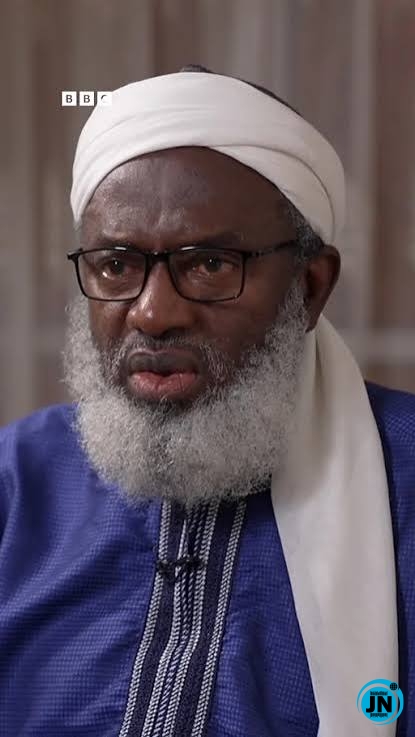
In his words, the cleric stressed that the military itself understands the limits of force in resolving internal conflicts.
“But even the military says that in dealing with this civil unrest and criminality, only 25% is kinetic action; the rest depends on the government, politics, and local communities. The military cannot do everything,” he said.
He further questioned the effectiveness of warfare against loosely organised armed groups, adding:
“Where have you ever seen the military defeat guerrilla fighters? Nowhere.”
Gumi’s comments come at a critical time, as President Bola Ahmed Tinubu’s administration rolls out sweeping security reforms. These include changes in military leadership and the declaration of a nationwide security emergency aimed at dismantling criminal networks responsible for kidnappings, extortion, and repeated attacks on rural communities.
Addressing persistent allegations that he has maintained links with bandit leaders, Sheikh Gumi firmly denied the claims. He explained that his previous engagements with armed groups ended in 2021, the year the federal government officially designated the bandits as terrorist organisations.
“I never went there alone,” he said, clarifying the context of his past involvement.
“It was in 2021 when I was trying to see how we could bring them together. But unfortunately, the government at the time, the federal government, was not interested. They declared them terrorists, and since that time we have completely disengaged from all contact with them.”
Despite facing widespread criticism from politicians and citizens who accuse him of legitimising violent groups, Gumi insists that negotiation with non-state actors is a globally accepted conflict-resolution strategy.
“When they say we don’t negotiate with terrorists, I don’t know where they got that from,” he remarked. “It is not in the Bible, it is not in the Quran. America had an office negotiating with the Taliban in Qatar. Everyone negotiates with outlaws if it will stop bloodshed.”
The cleric also shared his perspective on the root causes of the unrest, describing many of the armed groups operating in the northwest as Fulani herders pushed into an “existential war” by environmental pressures, shrinking grazing routes, and long-standing disruptions to their traditional cattle-rearing lifestyle.
“They want to exist. That is their life. They know where to graze and how to care for their cattle,” he explained, while acknowledging that the conflict has since gone far beyond farmer–herder clashes and morphed into large-scale criminal activity spreading across several regions of Nigeria.