
Senegal players briefly walked off the pitch during the closing stages of the Africa Cup of Nations (AFCON) 2025 final against Morocco, an incident that sent shockwaves through the stadium in Rabat and captured widespread attention on social media. The dramatic walk-off was prompted by a controversial late penalty decision, which escalated tensions and contributed to chaotic scenes both on the field and in the stands. The match, played at the Prince Moulay Abdellah Stadium, eventually extended far beyond the normal added time, underlining the extraordinary and emotionally charged nature of the contest.
The drama unfolded deep into stoppage time, with only eight minutes initially added, but the game stretched well over 100 minutes due to the delays caused by player protests and fan unrest. Senegal’s reaction to the penalty decision highlighted both the high stakes of the final and the immense pressure on players representing their countries on such a grand stage.
Penalty decision sparks walk-off
The controversy began when Senegal defender El Hadji Malick Diouf was penalised for allegedly pulling Morocco forward Brahim Diaz inside the penalty area, a decision confirmed after a VAR review. The referee’s call, awarding Morocco a penalty at such a critical moment, was immediately contested by the Senegal coaching staff and players. Adding to the tension, Senegal had a late goal from Ismaila Sarr disallowed earlier in stoppage time, amplifying frustration among the players and supporters.
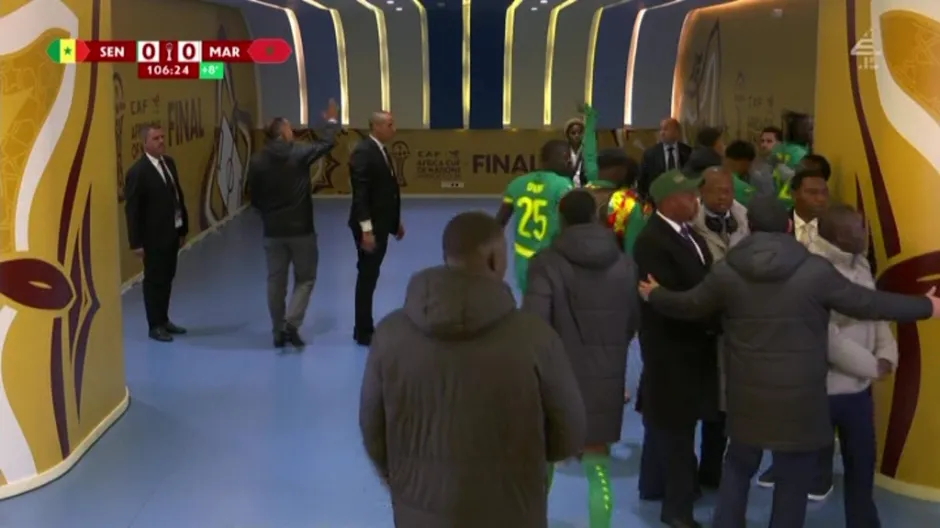
The tense atmosphere prompted Senegal head coach Pape Thiaw to instruct his players to leave the field in protest. Television footage captured the squad huddled near the touchline before several players headed down the tunnel, temporarily halting the match. The stoppage extended for over 15 minutes as confusion and agitation grew inside the stadium, leaving fans and officials in suspense over how the situation would be resolved.
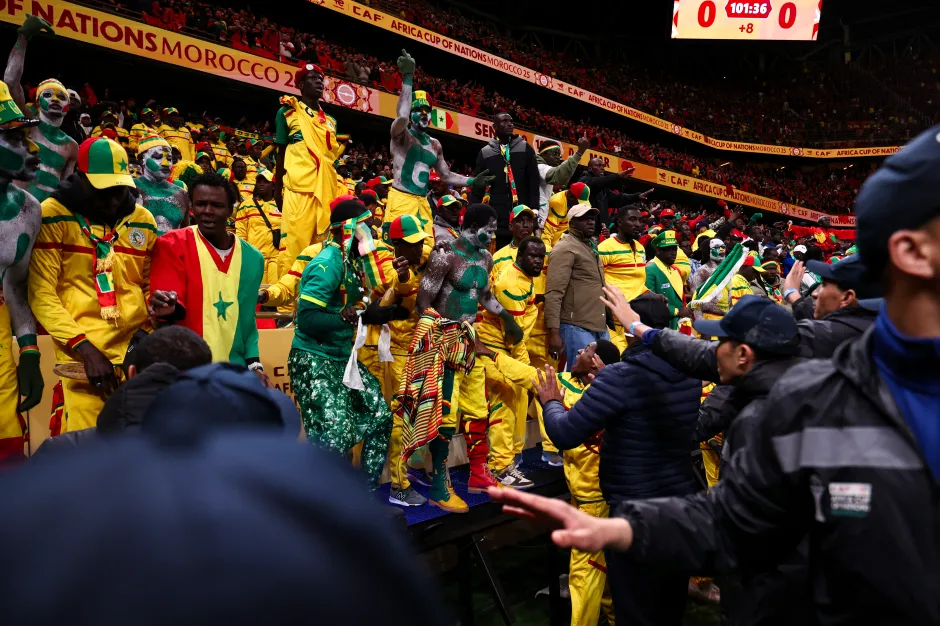
Amid the protest, security personnel remained on high alert, carefully monitoring the Senegal players and ensuring no further escalation occurred while the game was paused. The stadium staff worked diligently to maintain safety, with fans visibly frustrated by the ongoing disruptions.
Disorder spreads to the stands
The disruption on the pitch was mirrored in the stadium stands. Senegal supporters, frustrated by the controversial penalty, clashed with stewards, with reports indicating that some fans used chairs and other objects as weapons, attempting to approach the pitch. The escalating violence prompted a heightened security presence, including riot police, to restore order and prevent the unrest from spreading further into the stadium. The chaotic scenes illustrated the high emotions surrounding the match and the intense loyalty of supporters to their national teams.
Senegal captain Sadio Mane played a crucial role in de-escalating the situation on the pitch. He actively urged his teammates to return, even sprinting towards the tunnel to bring them back, ensuring the match could continue safely. His leadership was widely praised, as he managed to calm the players amid a highly charged environment, eventually seeing the squad re-emerge to continue the contest to the chorus of boos from the home crowd.
Sadio Mane was instrumental in calling the Senegal players back to the pitch 👏#AFCONFinal | #TotalEnergiesAFCON2025 pic.twitter.com/LV34ZuSoL4
— beIN SPORTS (@beINSPORTS_EN) January 18, 2026
Missed penalty turns the tide
Once the match resumed after the lengthy delay, Morocco forward Brahim Diaz stepped up to take the controversial penalty. Senegal goalkeeper Édouard Mendy, who had been booked earlier for protesting the call, made a comfortable save on Diaz’s panenka attempt, keeping the score level and extending the drama into extra time. The tense moments demonstrated Senegal’s resilience and set the stage for the decisive final moments of the match.
Former Nigeria midfielder John Obi Mikel, providing live commentary on E4, described the scenes as a “shameful end” for African football, stating: “For African football, this is a shameful end to this tournament… I can understand their frustration but walking off the pitch is not what I want to see.” His comments reflected widespread concern over the conduct of both players and fans during the critical moments of the final.
Extra time immediately followed, and Senegal seized the opportunity to capitalise early. Pape Gueye fired a powerful left-footed strike past Morocco goalkeeper Yassine Bounou, giving the Teranga Lions the lead and putting them in a commanding position to claim the title. Morocco continued to push forward, hitting the crossbar through Nayef Aguerd, but were unable to find the equaliser despite their efforts. Senegal maintained their composure and defensive organisation to secure a 1-0 victory after extra time.
The victory marked Senegal’s second Africa Cup of Nations title in three editions, while Morocco were left to reflect on a final defined as much by controversy, protests, and crowd unrest as by the football itself. The extraordinary events of the match—from the walk-off to the fan disturbances—ensured that this AFCON final would be remembered as one of the most dramatic and turbulent in recent tournament history.