
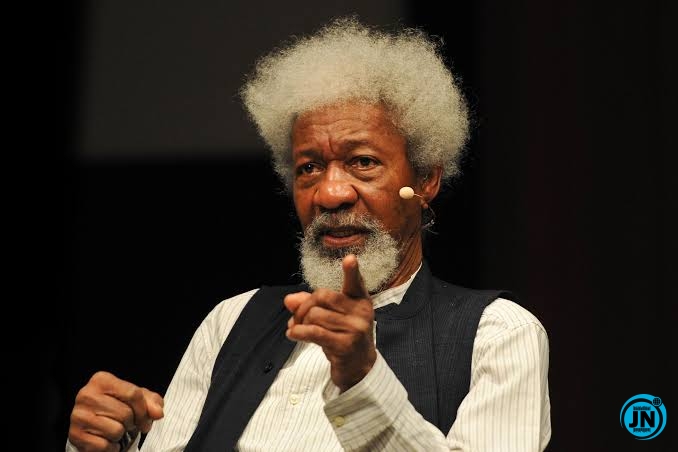
Nobel Laureate Wole Soyinka has voiced strong criticism of President Bola Tinubu over the Nigerian government's decision to deploy the Air Force and military forces to Benin Republic following the recent failed coup attempt against President Patrice Talon, arguing that the move was unnecessary and that simpler, less aggressive alternatives could have sufficed.
Speaking at the 20th Wole Soyinka Centre for Investigative Journalism (WSCIJ) Awards in Lagos on Monday, the acclaimed playwright and social commentator suggested in a lighthearted yet pointed manner that President Tinubu could have relied on his son, Seyi Tinubu, to manage the situation instead of mobilizing the military. Soyinka’s remarks highlighted his usual blend of wit, critique, and civic observation, as he questioned the proportionality of the response to the attempted insurrection.
Soyinka recounted a personal experience in Lagos, noting the extraordinary security detail surrounding Seyi Tinubu, which in his view demonstrated that the young man was more than capable of handling significant threats on his own. He described witnessing a scene at a hotel in Ikoyi, Lagos, where Seyi appeared amidst a highly armed team of security personnel, a presence Soyinka humorously suggested could rival the strength needed to take over a small neighboring country like Benin.
“I looked around and there was nearly a whole battalion occupying the ground of that hotel in Ikoyi,” Soyinka said, emphasizing the impressive scale of security surrounding the President’s son. “I saw the SWAT team, a mixture of heavily armed, at least 15 heavily armed to the teeth security personnel, looked sufficient to take over a small neighbouring country like Benin.”
He added: “President Tinubu didn’t have to send the Air Force and Military to deal with the insurrection to our sense of security and equilibrium; no, there are easier ways of doing it. Let me tell you where Tinubu should have looked for forces to quell that insurrection, right here in Lagos or in Abuja perhaps, but there was no need to call the military or the Air Force. I think the next time the president should just call and say ‘Seyi go and quell the rebellion over there.’ I was so astonished that I started looking for the NSA.”
Soyinka’s commentary drew attention not only for its critique of government decision-making but also for the subtle commentary on the optics and implications of relying heavily on military intervention in regional conflicts. By juxtaposing Seyi Tinubu’s heavy security presence with the military deployment, Soyinka underscored questions about efficiency, necessity, and alternative approaches to crisis management.
He concluded his anecdote by reiterating that smaller, strategic interventions, potentially involving trusted individuals like Seyi Tinubu in non-combatant roles, could achieve the intended security objectives without mobilizing an entire branch of the military, thereby avoiding excessive display of force and potential diplomatic tensions.
Watch video below …
“President Tinubu didn’t have to send the Air Force and Military to stop the coup in Benin, he should have sent his son, Seyi Tinubu instead.” — Prof. Wole Soyinka berates Seyi Tinubu’s use of heavy security.
— YabaLeftOnline (@yabaleftonline) December 9, 2025