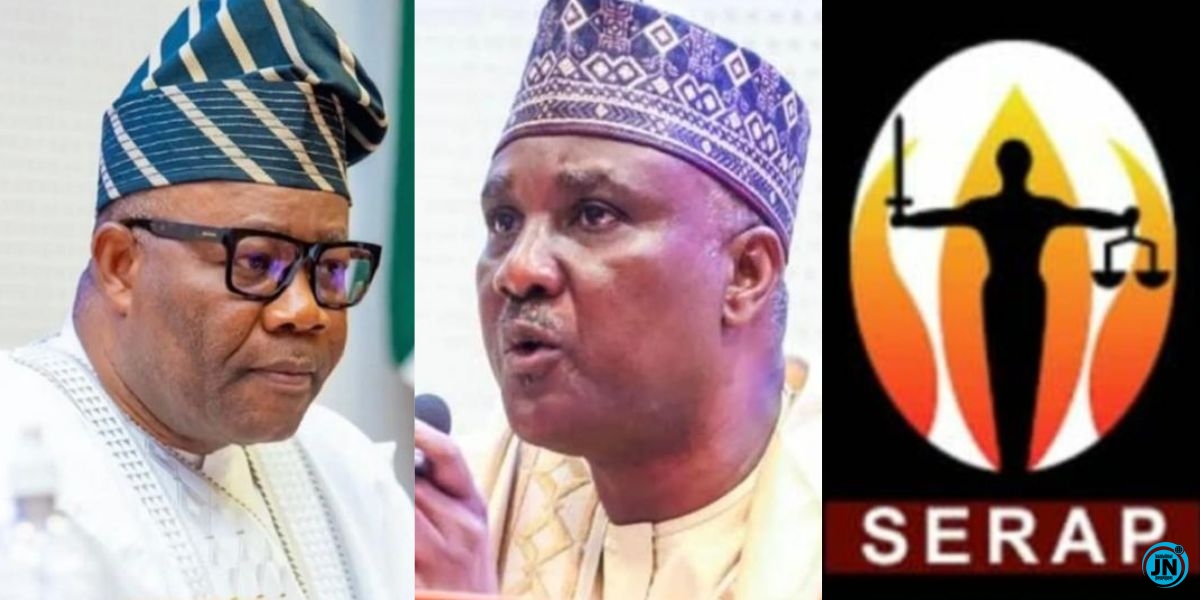
The Socio-Economic Rights and Accountability Project (SERAP) has filed a major lawsuit against Senate President Godswill Akpabio,[/b] Speaker Tajudeen Abbas, and the National Assembly Service Commission (NASC), demanding full accountability for the ₦18.6 billion allocated for the National Assembly service commission office complex in Abuja. The organization described the action as a crucial step toward exposing alleged financial irregularities and enforcing transparency in the management of public resources.
Akpabio and Abbas were sued personally and on behalf of all members of the National Assembly, following damning revelations in the 2022 Auditor-General’s Annual Report, published on 9 September 2025. The report flagged the entire ₦18.6bn spending as unjustified, unsupported, and unaccounted for, raising concerns over possible large-scale misappropriation of public funds meant for a critical national project.
The suit, marked FHC/ABJ/CS/2457/2025, seeks a court order compelling the National Assembly leadership and NASC to explain the whereabouts of the funds, disclose the name of the alleged “fictitious construction company” that received the payments, and release all documents related to the project. SERAP insists that such disclosures are necessary for Nigerians to understand how such a large sum of money could have been disbursed without proper documentation or evidence of work done.
SERAP is also demanding assessments, bid advertisements, quotations, contract agreements, minutes of the Tender Board meetings, and Federal Executive Council (FEC) approvals for the project. According to the group, the absence of these documents points to clear violations of Nigeria’s procurement laws and processes, which are designed to prevent fraud, waste, and abuse of public funds.
According to the organisation, the alleged diversion or mismanagement of the ₦18.6bn is a grave breach of public trust, a violation of the Nigerian Constitution, and a direct breach of international anti-corruption standards. SERAP insists that Nigerians have a right to know how the funds [/b]were used and who collected the money, stressing that secrecy in public spending only fuels corruption and distrust in governance.
The suit, filed by SERAP’s lawyers, Kolawole Oluwadare, Kehinde Oyewumi, and Andrew Nwankwo argues that the National Assembly must uphold the principles of transparency and accountability, especially when managing public resources. The legal team emphasized that democracy cannot thrive in an environment where lawmakers themselves are accused of failing to account for billions of naira entrusted to them.
The Auditor-General’s report revealed that over ₦11.6bn was paid to an “unknown construction company” in 2020 for the complex project, with the contract allegedly inflated by an additional ₦6.9bn paid in 2023. The report questioned why such huge amounts were released without clear evidence of work done or verification of the identity of the contractor.
The report further noted that both contracts were awarded without a Bill of Quantity (BOQ), without needs assessment, without newspaper advertisements, without bidding, without quotations, and without FEC approval. These lapses, according to the Auditor-General, strongly suggest deliberate circumvention of due process and possible efforts to conceal the true nature of the transactions.
There was also no Bureau of Public Procurement (BPP) Certificate of No Objection. The Auditor-General fears the entire ₦18.6bn may have been diverted or stolen and wants a full account of the money, including whether any portion of the project was actually executed on ground.
SERAP added that corruption continues to worsen poverty in Nigeria, denying vulnerable citizens access to essential services such as healthcare, education, and infrastructure. The group argued that money allegedly mismanaged by lawmakers could have been used to improve the lives of millions of Nigerians.
The group emphasised that the National Assembly has a constitutional duty to protect public funds, ensure transparency, and uphold anti-corruption laws. It warned that failure to do so would further weaken public confidence in democratic institutions and the rule of law.
The organisation also highlighted Nigeria’s obligations under the UN Convention Against Corruption, which require proper management of public resources and strict accountability from public institutions. SERAP insists that these international commitments must not just be symbolic but enforced through concrete legal action.
As of now, no hearing date has been fixed for the case, but SERAP has vowed to pursue the matter to its logical conclusion until full accountability is achieved and the truth behind the missing ₦18.6 billion is uncovered.