
Former African Democratic Congress presidential candidate and renowned political economist, Pat Utomi, has recounted the difficulties he faced during a recent journey from Lagos to Benin, shedding light on what he described as a deteriorating state of road travel and alleged misconduct by law enforcement along the route.
Utomi detailed his experience in a post shared on his official X account, formerly known as Twitter, where he provided a timeline of events, described poor road conditions, and accused police officers of attempting to extort money from travelers during the trip.
Long journey on a once-short route
According to Utomi, the road conditions and delays he encountered highlight how significantly road travel in Nigeria has declined over the years. A route that previously took around three hours in the 1980s now consumes nearly a full day to traverse due to traffic congestion, bad roads, and policing practices, he explained.
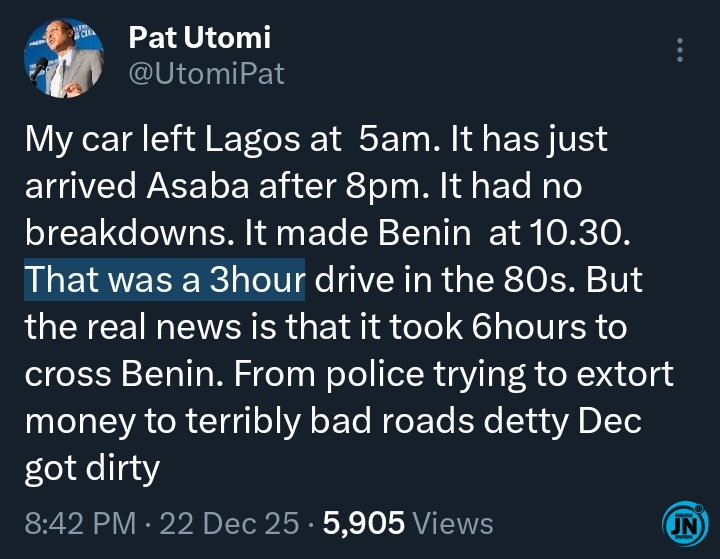
He noted that his vehicle did not experience any mechanical faults, yet the journey was prolonged primarily due to external factors such as poor infrastructure and law enforcement interventions. He recounted: “My car left Lagos at 5am. It has just arrived Asaba after 8pm. It had no breakdowns. It made Benin at 10.30. That was a 3hour drive in the 80s.”
He continued, emphasizing the difficulties encountered crossing Benin: “But the real news is that it took 6hours to cross Benin. From police trying to extort money to terribly bad roads detty Dec got dirty.” His remarks painted a picture of significant challenges faced by ordinary road users, even when traveling under safe and reliable circumstances.
Netizens react to Pat Utomi road ordeal
The revelations about the Pat Utomi road ordeal quickly ignited debate among Nigerians on social media, with reactions ranging from agreement and concern to criticism of his perspective.
Some users expressed support for Utomi’s observations, acknowledging the poor state of the roads and the potential for harassment by law enforcement. Callis wrote: “Prof. congratulations, your car arrived early. Most vehicles don’t make the trip in one day anymore because of bad state of the roads.”
Other users offered differing viewpoints, highlighting ongoing road construction and advising patience. Twuyi-Asiwaju commented: “Are you not aware about road construction going on in that axis or you’re trying to be naive about the situation. People witnessed traffic situation anywhere in the world when repairs are going on Oga. Together let us build our country not with negative reports.”
Some users suggested alternative travel options to avoid the challenges Utomi faced. Noble remarked: “Prof, thank God your car arrived safely. May I humbly suggest, if you may try the water ways via CMS-Ababa. That you will be rest assured no police trying to extort money at the checking points or traffic due to bad road. I have not seen or heard potholes on Nigerian waters.”
Other reactions were more politically charged, linking the road ordeal to broader criticisms of government management. Ademolawa wrote: “While IGP and his boys with some unknown pastors are celebrating the Christmas carol under the prince of peace canopy. Now a disgraced administration in a now disgraced country.”
Similarly, Davidson commented: “Pat, Since we are shouting that this government is a disgrace, Maybe you didn’t understand. Thank God you went and you saw. Davil Umahi is part of this disgraced government, Tinubu is working.”
The Pat Utomi road ordeal has reignited public debate about the condition of Nigeria’s roads, the conduct of police officers, and the broader state of infrastructure management. Many Nigerians see his experience as illustrative of systemic issues that affect daily commuters and travelers, prompting calls for urgent reforms to improve road safety, reduce corruption at checkpoints, and enhance overall transportation infrastructure across the country.