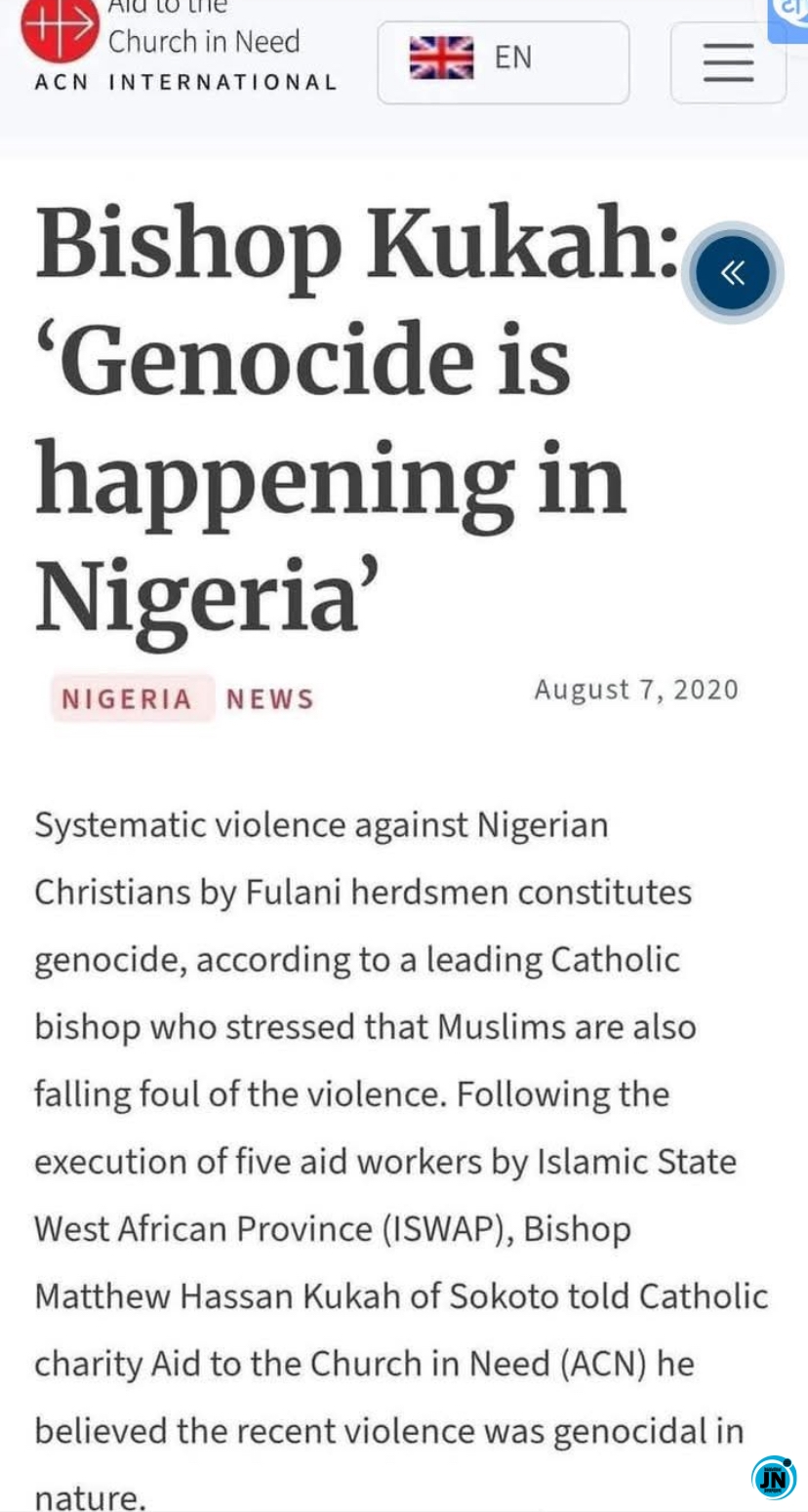
Nigerians have dug up past comments by Bishop Matthew Kukah following his recent viral remarks denying an ongoing genocide/ persecution of Christians in Nigeria.
The Catholic Bishop of Sokoto Diocese and Convener of the National Peace Committee (NPC) recently insisted that claims of Christian persecution are exaggerated, stressing that genocide should be determined by intent rather than the number of casualties.
He also argued that Christians hold a strong position in Nigeria’s society and economy, and that discussions about persecution must be based on accurate data.
His comments quickly stirred reactions online, with many Nigerians expressing surprise and disagreement, especially given the years of violent attacks and insecurity that have plagued several parts of the country.
Some social media users accused the cleric of downplaying the suffering of Christian communities, while others defended him for calling for careful analysis and factual clarity rather than emotional conclusions.
2020 Statement Reemerges
However, social media users quickly reshared Bishop Kukah’s 2020 comments, in which he appeared to describe violence against Christians [/b]as genocidal.
In an interview with Catholic charity Aid to the Church in Need (ACN), he stated that systematic violence against Nigerian Christians perpetrated by Fulani herdsmen constituted genocide.
He further noted that the execution of five aid workers by the Islamic State West African Province (ISWAP), three of whom were reportedly Christian, was part of a broader campaign of terror.
These resurfaced statements have caused many Nigerians to question what they describe as a sharp contrast between his past views and his present position on the matter.
Some critics argue that the comments appear contradictory, while others suggest the change may reflect new data, political sensitivity, or evolving personal perspectives.
Criticism of Government and Security Agencies
Bishop Kukah also criticized the Nigerian government and security agencies, saying:
“There are multiple levels of funding and, with time, terrorism has been able to fund itself by criminality, violence, kidnappings… Governments have also paid huge sums of money for ransom… The inefficiency of the military has made the terrorists bolder, and there are issues of complicity at various levels.”
According to him, these weaknesses within the system allowed violent groups to operate with little fear of consequences, thereby worsening insecurity and undermining public trust in authorities.
Failed State and Western Powers
He highlighted Nigeria’s struggles as a failed state, adding: “The evidence is there for all to see that Nigeria is an epicenter of terrorism in the region.”
The bishop also criticized Western powers for offering promises that yielded little action, saying:
“We hear promises from the United States and Europe and they all come to nothing.”
The resurfacing of these statements has sparked widespread debate among Nigerians, with many questioning the apparent shift between Bishop Kukah’s 2020 assessment and his recent denial of ongoing genocide.
Others, however, believe his remarks underline the complexity of the crisis, insisting the conversation should go beyond emotional narratives and focus on long-term solutions and accountability.
See below;