
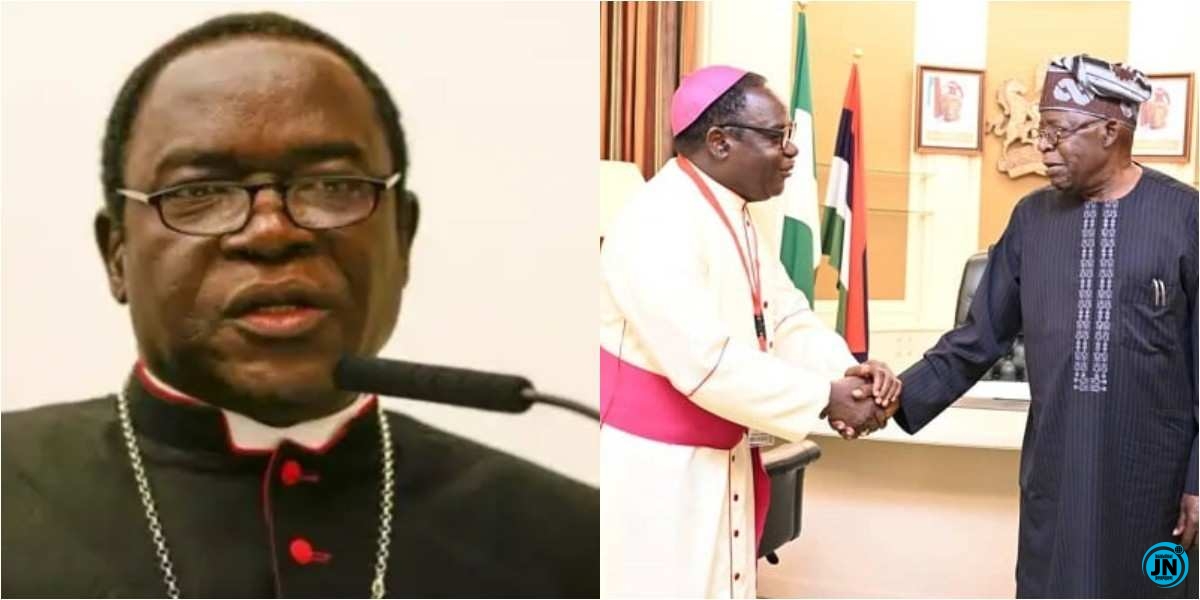
Bishop Matthew Kukah, the Catholic Bishop of Sokoto Diocese and Convener of the National Peace Committee (NPC), has once again sparked discussion after addressing widespread claims regarding the persecution of Christians in Nigeria. In a detailed clarification, he stated that there is currently no evidence of genocide targeting Christians in the country and emphasized that the legal definition of genocide is determined by the intent to systematically eliminate a particular group, rather than the sheer number of casualties or isolated acts of violence.
Context and Misconceptions About Christian Persecution
Bishop Kukah’s remarks come amidst ongoing debates and controversies on social media and in international circles, where narratives of Christian persecution have frequently gained traction. The bishop noted that while violence exists in certain parts of Nigeria, labeling the situation as genocide without careful analysis can be misleading and potentially harmful to national unity.
He criticized the tendency to use alarming statistics without proper verification, arguing that many figures circulating online, such as claims that 1,200 churches are burned annually, lack corroboration and should not form the basis of broad accusations. “Interestingly, nobody approached the Catholic Church to get accurate data. All those talking about persecution—has anyone ever called to ask, ‘Bishop Kukah, what is the situation?’” he questioned, highlighting the importance of factual reporting and verification.
Aligning With Catholic Leadership
During his presentation at the 46th Supreme Convention of the Knights of St. Mulumba (KSM) in Kaduna, Bishop Kukah reiterated that his views are consistent with those of the Vatican Secretary of State, the President of the Catholic Bishops’ Conference of Nigeria, and other Catholic bishops across the nation. He stressed that his position is grounded in extensive research, including a 1,270-page study on genocide and international standards on what constitutes systematic persecution.
He cautioned against conflating individual acts of violence with targeted campaigns meant to eliminate a specific religious or ethnic group, explaining that context and intent are key in understanding such complex issues.
Genocide Defined by Intent, Not Numbers
Bishop Kukah elaborated on the legal and academic understanding of genocide, emphasizing that mass killings alone do not constitute genocide unless they are carried out with the deliberate intention of eradicating a group. “You can kill 10 million people and it still won’t amount to genocide. The critical determinant is intent—whether the aim is to eliminate a group of people,” he explained, urging analysts, media, and religious leaders to exercise caution when labeling events as genocide.
He highlighted that misunderstanding the term can escalate tensions, foster mistrust among communities, and provide opportunities for extremists to exploit such narratives for their own agendas.
Christians’ Position and Influence in Nigeria
In addressing claims of systemic persecution against Christians, Bishop Kukah highlighted their prominent role in Nigerian society and the economy. He pointed out that approximately 80% of educated Nigerians are Christians and that up to 85% of the country’s economic activities are controlled by Christians. “With such figures, how can anyone say Christians are being persecuted?” he asked, urging people to differentiate between localized incidents of violence and widespread systematic oppression.
The bishop also stressed the importance of internal unity within the Christian community, explaining that disunity often exacerbates the perception of vulnerability. “The main problem is that Christians succumb to bullies. The day we decide to stand together—believing that an injury to one is an injury to all—these things will stop,” he added, highlighting the need for collective solidarity and strategic advocacy.
Clarifying Martyrdom and Media Narratives
Bishop Kukah further addressed claims of martyrdom, warning against automatically labeling victims of violence as martyrs. He stated, “Because someone is killed in a church, does that automatically make them a martyr? Whether you are killed while stealing someone’s yam or attacked by bandits, does that qualify as martyrdom? We must think more deeply.”
He noted that sensationalized reports of martyrdom can distort public perception, inflame religious tensions, and undermine the credibility of genuine cases where persecution is evident. According to Bishop Kukah, careful assessment and contextual understanding are critical before issuing statements that may affect national discourse.
Research-Based Perspective
Emphasizing the scholarly basis of his statements, Bishop Kukah revealed that his conclusions were drawn from a comprehensive 1,270-page study on genocide in Nigeria and comparable contexts globally. He stressed that while violence and criminality exist, there is no substantiated evidence that Christians in Nigeria are currently experiencing genocide or mass-scale persecution. “People say there is genocide in Nigeria. What I presented at the Vatican was a 1,270-page study on genocide in Nigeria and elsewhere. My argument is that it is not accurate to claim there is genocide or martyrdom in Nigeria,” he clarified.
The bishop called for a more nuanced and informed discussion about security challenges, religious tensions, and societal dynamics in Nigeria, urging both local and international actors to rely on verified data rather than emotionally charged narratives or unverified reports.