
Daniel Regha, the outspoken social media commentator known for his sharp political insights, has once again stirred a heated discussion online following his reaction to the recent political defection involving Atiku Abubakar’s son.
Reports reveal that Abba Abubakar, the son of former Vice President Atiku Abubakar, has officially left the Peoples Democratic Party (PDP) and joined the ruling All Progressives Congress (APC) in Adamawa State. This move comes as a surprise to many given his father’s known political plans and longstanding affiliation with the opposition.
Defection causes political stir
According to multiple sources, Abba Abubakar publicly declared his support for President Bola Tinubu’s 2027 re-election bid immediately after his defection to the APC. The announcement has captured widespread attention, largely because Atiku Abubakar himself is reportedly preparing to contest the presidency in the same election cycle, representing the opposition under the African Democratic Congress (ADC) platform.
Political analysts suggest that Abba’s move may have far-reaching implications for Atiku’s campaign strategy, potentially signaling cracks within the family’s political influence or hinting at an early maneuver to gain favor within the ruling party. The development has inevitably generated conversations around loyalty, family dynamics, and generational political divergence in Nigeria’s political landscape.
Regha’s commentary sparks discussion
Reacting to the development, Daniel Regha shared his thoughts on social media, questioning the political and familial implications of Abba Abubakar’s decision. In his post, Regha reflected on the irony of a father running for high office while his own son appears to reject his vision and align with the opposition. He wrote:
“Imagine running for office and your own son doesn’t believe in your vision, that he had to side with the opposition you jumped ship to oppose. Speaks volumes.”
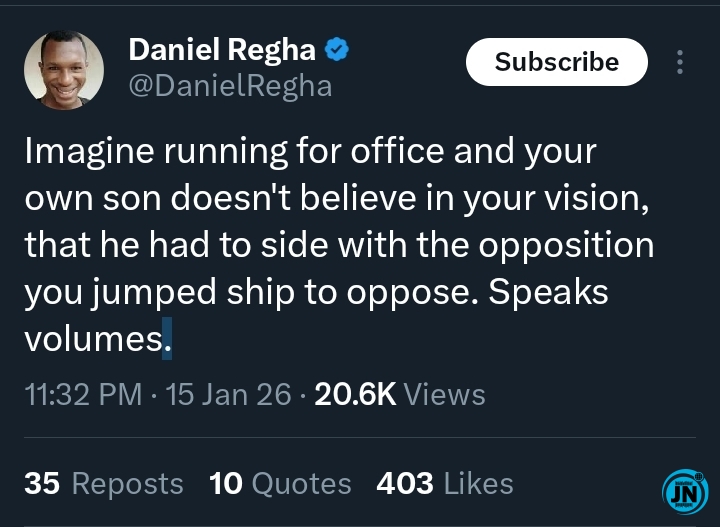
Regha’s post quickly went viral, drawing thousands of reactions from Nigerians across multiple social media platforms, with users offering diverse interpretations of what the defection signifies for Atiku, his son, and the broader political landscape ahead of the 2027 elections.
Mixed reactions from Nigerians
Many Nigerians took to social media to share their thoughts, often offering conflicting perspectives on the significance of the son’s political choice. Maximum commented: “If your own family and friends can openly show they don’t stand with you, then nobody should stand with you. Charity begins at home.”
Celestine added: “That’s politics for you bro. By so doing, the boy is also trying to gain his own supporters or fans.. remember, he’s just starting his political journey. It’s just a game.”
Newman weighed in from a comparative standpoint, saying: “This is what is currently happening in Uganda with the incumbent president.”
Lumii criticized Atiku’s approach, noting: “Atiku doesn’t even believe in his vision, so I don’t blame the son.”
Southwest speculated on strategic motives: “It’s all mind games lol, Atiku knows he can never rule Nigeria so he’s pushing his son in front to gain power and publicity.”
Osisanya suggested a calculated plan behind the move: “Only a man born in the 20s will believe Atiku’s son joined APC to support APC. He joined APC to de$troy the party from the inside, create ch@os and all that. You guys should learn how to play chess.”
OAI drew historical comparisons: “I remember when this same plays out in Bangladesh in 1807…. Just let’s stop there.. The bottom line is that Atiku needs to call for a broad family meeting… It’s a sign to be worried about.. Oju tio bani Dale, koni to’ro se ipin..”
Chuks offered a lighter analogy, noting: “It’s normal someone father can be a pastor of a church but his children worship with another church.”
The wide range of opinions reflects the complexities surrounding familial loyalty and political alignment, especially in high-profile political families. As debates continue online, Nigerians remain divided, with some interpreting Abba’s defection as a personal betrayal and others seeing it as a strategic move for his own political future. The story highlights the intersection of family, politics, and generational perspectives in contemporary Nigerian politics.[/p>